Thursday, July 11, 2013

East Berlin: What we Saw, What we Learned

Before I begin: we have been a bit lax about keeping up with the blog.  Seeing our friends and family (and, of course, the sights) in Berlin, Amsterdam and Leuven (Belgium) has been wonderfully taking up our time.  But we still wanted to share what we learned about East Berlin.

One of the first sites we went to (just a block away from Checkpoint Charlie) was a small museum dedicated to telling how the "Ministerium fur Staatssicherheit" - also known as the Stasi - operated and controlled the activities of the people, housed in part of the building where they operated.  It was quite informative, showing how they kept a file system and several things that they had a hand in, including travel, arts, work, etc.  It showed one particularly funny document that condemned a guy as being a "Punk Rocker."  It also discussed how it shut down a theater group using what they called "psychological methods."  Apparently, after the Stasi was shut down, people could go and find their files to see what the Stasi had dug up on them.  There was also a larger museum on the Stasi and Gestapo, but we didn't manage to see it.

Street leading up to Alexanderplatz
On another day, we ventured into East Berlin to see what it looked like.  Our first stop was Alexanderplatz, a square in what used to be East Berlin that has retained some of its socialist character, as you can see from the picture at right.  Also, because it was redeveloped in the 1960s to become the East Berlin city center, it is where you can find a few important structures.  One of these is the world time clock, or the Weltzeithur (below), which shows the hour at each of the different time zones with example cities in each time zone.  It is also topped by a rotating solar system.


Also in this picture, you can see the Fernsehturm, or the TV tower.  According to this site, the history of the tower goes a little like this:

Construction for the GDR transmitter started in the 1950s and the tower erected between 1965-69 was intended as the tallest tower in Europe second only to Moscow’s own TV tower.

[...]

The tower’s second legend is that although it was intended to demonstrate technological advance it was doomed to an ironic fate. To the embarrassment of GDR authorities – the steel sphere below the antenna produced the reflection of a giant cross. Hence the popular joke, not appreciated by the SED government, that this was God’s revenge on the secular socialist State for having removed crucifixes from churches.

We continued on through Alexanderplatz to Karl-Marx-Allee (Boulevard, if you like). This street is pretty interesting.  Beginning in 1949, it was actually called Stalinallee, and was sort of meant to be the place where Stalin could showcase how awesome East Berlin was, and by extension, how awesome socialism was.  At right, we took a selfie with the street sign (like classy folks), and below you can see an example of the architecture meant to show socialism's strength.

In 1961, the street was renamed Karl-Marx-Allee as part of the process of "deStalinization" (that was actually the term used on a sign we saw, no relation to the process of removing salt from water, desalinization).  One of the blocks we walked down apparently used to have a giant statue of Stalin, but as you can imagine, that was also removed.


One quite nice thing about Karl Marx Allee was that they put signs up for people interested in the history of the place.  If you're ever in Berlin, there's a free, English-language tour of Karl-Marx-Allee via these interesting and informative signs.  We would recommend them if you have a free afternoon.  They look like this  --------------------->


One of the other sort of funny things we saw along this street was Cafe Moskau/Москва.  It was a formidable building, complete with giant mosaic of people of the world (ostensibly happy with their lives under socialism) as well as the giant name of the restaurant flanked by a Sputnik lookalike.


Note that the sun in the mosaic (top left, not all too visible in this picture, sorry) is also modeled on Sputnik.


The whole display reminded me of this song (a version with English lyrics like "love tastes like caviar," if you like) which I then had in my head for the rest of the day.  By the way, I talked to our host Carla about this song and she said it sort of occupied a similar cultural niche as "The Chicken Dance" does in our culture.  Or "Don't Stop Believin'."  Or "Bohemian Rhapsody."  Basically the song you play at the end of the party.


Back from my digression to East Berlin!  We had the amazing opportunity to eat dinner with Carla's family.  Her father was able to give us a few really interesting insights into how life was in Berlin.  They lived in West Berlin, and among other things told us about the difficulties that posed for traveling.  West Berlin was, after all, was surrounded by East Germany.  The Cold War and the Communist regime posed their own problems for East Germans; they in effect could only travel to other communist countries.

Another thing Carla's father told us about was how difficult it was for East Berliners to buy daily necessities.  He told us about someone he knew who was buying some sort of construction material (I forget exactly what) just after reunification.  He called the store and when he asked how much they had, he was surprised to hear them say he could order as much as he wanted.  He apparently then ended up ordering much more than he ended up needing.

Carla also told us how the desire to have 'modern-looking' buildings also affected West Berlin.  In fact, West Berliners were paid to remove traditional decorations from the facades of their buildings at the time to make them look more modern.  Later on, she told us, some people put the decorations back up, but it often didn't quite look the same.

All in all, Berlin was definitely one of our favorite stops, as I mentioned before.  We learned a lot from people whose lives and families were actually affected by the developments of the last several decades.  Thanks again, Carla and Johannes, for hosting us and helping us understand more about Berlin!

Sunday, July 7, 2013

Mix of Berlin: wall art, antiquities at the Pergamon, and currywurst

Our last post dealt with the Berlin Wall and some of the remaining scars in the city, but we didn't get the chance to post these portraits on former sections of the wall (moved a bit from their former position). Qaddafi's section (second from left) has mort spray painted on it - 'dead'. This will be all of our fate, but how long for example does Omar Al-Bashir have?


How long does Bashar Al-Assad have?


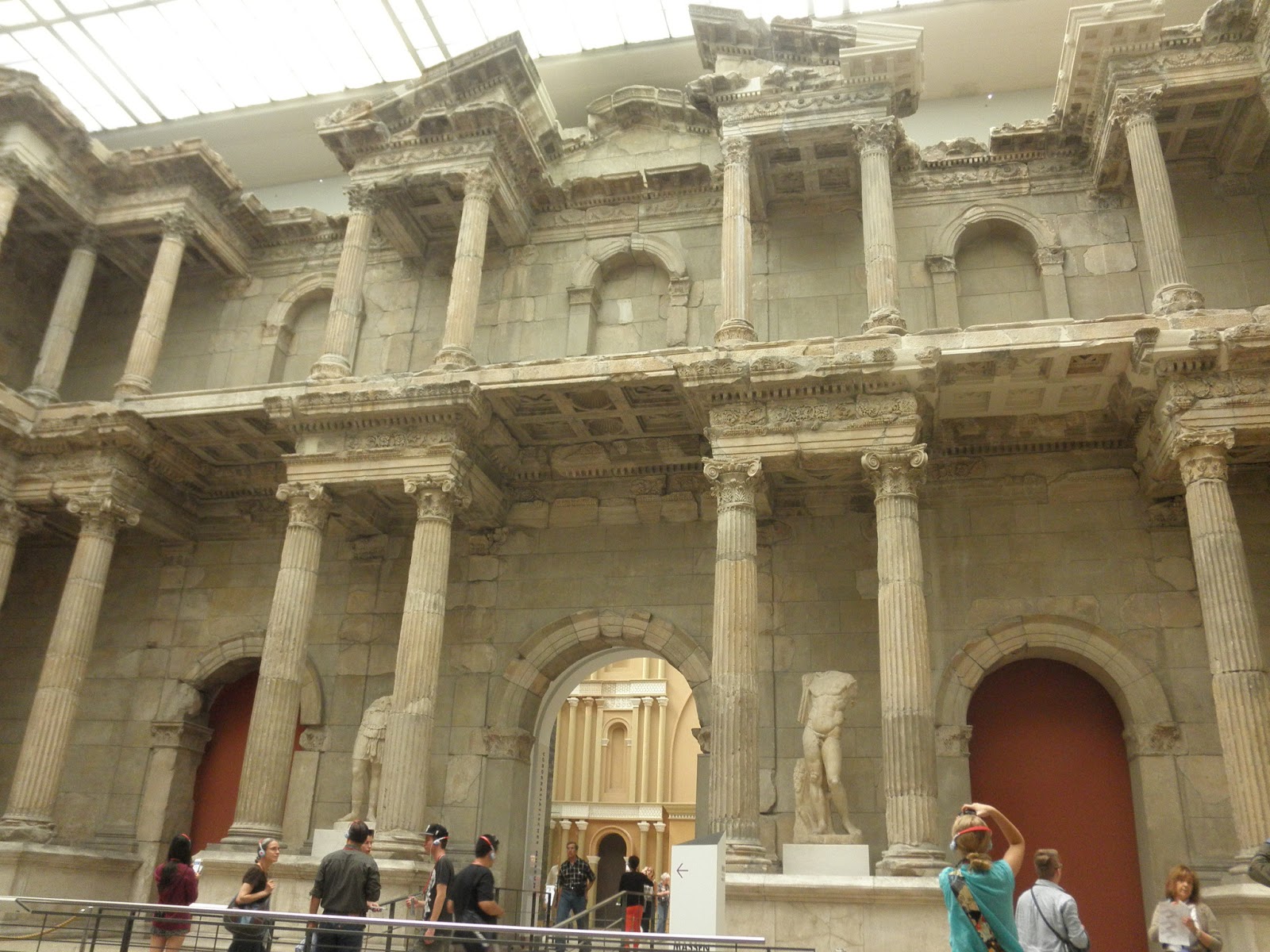
One of the highlights of Berlin is the absolutely incredible Pergamon Museum, named after the incredible Pergamon Altar, a 2nd century BC Greek temple excavated and carted off to Berlin for this museum. The entire temple complex was surrounded by a frieze depicting the gods battling Gaia's giant children. While damaged in spots, the total effect is breathtaking.


From that room, you pass to a second room with the following view, merely an entrance to a Roman market!


Emily and I (and others we've talked to) agreed that the real highlight of the Pergamon is not the Altar itself, but rather the Ishtar Gate, a huge gate of Babylon. Or, rather, not even the gate itself because that was too big to put in a museum but rather the inner gate. The gate is decorated with dragons and aurochs (now-extinct wild cattle) and was used annually in New Year's celebrations for the procession of deities into the city.


It's a bit hard to see in the smaller picture, but the larger one shows this inscription well:


While in Berlin, we knew we needed to try the famed local currywurst - a curried sausage. We paid for a small plate that comes sprinkled with curry powder and with a small bun:


Not even our enthusiasm could save our mediocre currywurst, unfortunately. The sauce tasted like a straight commercial barbecue sauce and there was so little curry powder that you couldn't taste it over the barbecue sauce. Oh well!


Our next post will cover a bit more of East Berlin stories and adventures. Stay tuned!

Friday, July 5, 2013

Berlin: The War and the Wall

First, I’m a bit bummed to be leaving Berlin.  It was certainly one of my favorite stops thus far, as I suspected it would be.  Carla and Johannes were amazing hosts to us and we had a lot of fun with them.  We also really enjoyed hearing their perspective on the things we were learning and hearing their tips on what to do.  Concordians, Carla and Johannes say hi!


The War
Instead of mentioning sights in the order we saw them, I think I’ll go by chronological order of the history that each of the sights we saw were referring to, starting with World War II.  Probably the most World War II history we saw was in the Berlin Jewish Museum (it seems most of Berlin focuses more on the Wall, which I’ll talk about in just a bit).  The Jewish Museum actually recounts ~1600 years of German Jewish history of which the Holocaust, or Shoah (the Hebrew word used to refer to the Holocaust), is only a part.  Parts of the museum focus simply on daily life, which likely applied to not just Jews but all Europeans of that age, but the museum also tells about movements of Jews based on where laws allowed them to live.  One recurring theme, it seems, is being invited into towns specifically to become bankers and moneylenders.  This happened because Christians were forbidden from collecting interest on loans to other Christians, which ended up leaving towns needing people to fill these roles.  However, even though this was specifically a role they were given and not one that they really chose, Jews were disliked for this role in society, stereotyped as miserly and many times kicked out of the places where they had established their lives.  The museum also addresses success stories, but it is in the context of this recurring persecution that the museum handles the Holocaust.

Some of the most powerful stories from the Holocaust are actually not in the main part of the museum but in the basement leading into the main part of the museum.  Here, there are exhibits of people’s personal items, letters to family members, etc.  Another part shows the work of the artist Bedrich Fritta, who was in the concentration camp/ghetto Theresienstadt, a prisoner employed to create positive propaganda about the camp.  On the side, though, he created drawings regarding his time in the camp that were at turns sardonic and haunting.  One of the most touching parts of that gallery is a book of cartoons he drew for his son who was turning three in 1944.  His son would survive the camp, though the artist did not.


An adjacent room has an art installation called “Fallen Leaves.”  It is a room whose floor is scattered with different sizes of welded iron faces with their mouths gaping open.  The room is meant to be walked into, though in order to do so you have to step on the faces.  The harsh sound of the metal faces clinking against one another is an intentional part of the installation.

Another part of the museum is the “Garden of Exile,” where huge concrete columns rise at a slight tilt out of the ground, which is also tilted.  It commemorates the Jews who escaped the Holocaust by moving all over the world.  It’s a quite effective monument – because of the tilt, walking between the columns throws your equilibrium off and disorients you; plus, you never know what’s around the corner and can only see in one direction at a time.  The audio guide had the architect mentioning how this was intentionally supposed to mirror the experience of the Jews who had fled.


A very similar monument, but much larger (2700 concrete columns instead of 16) lies in the heart of Berlin just next to the beautiful Tiergarten park: the Holocaust Memorial.  It is similar enough that we wondered if the artists had meant it to be that way. One major difference other than scale, though, is that whereas the columns in the museum were square, these are rectangular, reminiscent of a grave plot.


 A final acknowledgment of the events of the second World War came not in the form of a large monument, but in the form of small engraved metal blocks integrated into the sidewalks, like the one pictured right here.  These commemorated not only where they lived but when and how they died.  These were perhaps the most powerful, if the most understated, reminders of the Holocaust.


So, Mom, you mentioned you’d like to hear “Germany explains Nazism.”  It seemed to us that the tack taken in Berlin was not one of attempting to explain what happened, but rather reflecting in a somber way and, especially in the case of the Holocaust Memorial, in a very public spot.  There is no text on the Memorial, just the implicit reminder of what happened, as if it were warning all to be wary of history repeating itself.


The Wall
As you might remember, after the war, Germany was a country divided between the Soviets and the western powers (the US, Britain and France).  Berlin in particular was quite literally divided with a wall separating West and East Berlin.  Our first stop on the wall was Checkpoint Charlie, so named because it was the third checkpoint after Checkpoint A (Alpha) and Checkpoint B (Bravo) using the NATO phonetic alphabet.  It was one of the most well-known checkpoints at which people could attempt to cross between West and East Berlin, marked with the army checkpoint (below) and the sign warning you that you are leaving the American sector.  By the way, in addition to the American sector, there was also a French sector and a British sector.  Nowadays, as you can tell, it’s quite the tourist destination, complete with a McDonald’s across the street.


The wall next to the Checkpoint, and throughout the city, is now marked by a line of bricks (below).


Checkpoint Charlie turned out to be a fortuitous first stop, as it had a big informational exhibit that basically reviewed everything I had forgotten from AP European History about what happened in Germany after WWII, and by extension, the entire Cold War – things like the Cuban Missile Crisis, the Marshall Plan, the uprisings against Soviets in Hungary and the Czech Republic, and the Vietnam War.


The Checkpoint was particularly important as it became the main way that people attempted to get from East Germany to West Berlin (and from there to places far and wide).  The Checkpoint told the stories of hundreds of people who fled East Germany in that area, successfully or unsuccessfully.  Anyone who attempted to flee was considered an enemy of the state
.  People got creative – creating hiding spaces in cars, procuring US Army uniforms that would allow them to cross, falsifying documents, etc.

After brushing up on our history, we stopped by the Brandenburg Gate.  The Gate, built in the 18th century, became a lasting symbol of Berlin.  It was famous enough to get the attention of Napoleon during his reign, and apparently important enough to not be destroyed during the division of Berlin.  The Gate was just next to the wall on the East Berlin side, and there was a checkpoint there that theoretically allowed people to pass between.  During Reagan’s presidency, he is famously known to have given a speech on the gate, commonly quoted as saying “Mr. Gorbachev!  Tear down this wall!”  Apparently Obama recently visited Berlin and also spoke on the gate, but his speech was declared distinctly not as memorable.  Oh well.

A bit south of the gate lies Potsdamerplatz, a plaza full of modern buildings and a few pieces of the wall still in their original spots.  The entire plaza had been engulfed by the wall system (which, I should say, encompassed not just the one wall, but a whole militarized zone between two walls that allowed the East Germans to keep a very close watch on who crossed from East to West).  Potsdamerplatz, then, represents a bit of a phoenix rising out of the ashes, and that is why all of the buildings there are so modern.


\

One of our last stops in Berlin was to see the East Side Gallery, which is the longest remaining section of wall, still in its original position.  Both sides are heavily graffitied, but on the Eastern side of the wall the walls are covered in murals from when the wall was being dismantled and forward.  Many of the murals refer to peace, liberation, etc.  


One of the most famous panels depicts Soviet leader Leonid Brezhnev and East German President Erich Honnecker kissing (which, by the way, was painted from an actual picture)


The Wall was one of the things I was most excited to see on this trip. It’s a piece of history I was actually alive for, something that affected people I actually know, like Carla and Johannes and their families. Though they were quite young when the wall fell, it was really special to learn from them about what living in Berlin since then has been like. In our next post, we’ll tell you what we learned about what it was like to live in East Berlin.

Tuesday, July 2, 2013

Prague Blague

We just left Prague, apparently one of Europe’s largest tourist destinations.  We really only spent a day and a half there, though, which may have been giving it very short shrift.  On the other hand, it kind of seemed like there wasn’t a whole lot to do.  Prague seems to have two main attractions – 1. The beauty of the city itself, which is formidable - 
The Astrological Clock on Prague's City Hall

In Prague's main square


-        and 2. Their 2-for-1 variation of the castle on a hill/church motif, i.e. a castle on a hill *containing multiple churches.*

Inside St. George's Basilica, also in the castle
St. Vitus Cathedral inside Prague Castle
Participating in Prague's main activity

Now, most people go to Prague for a different attraction: the beer.  We participated in this to a certain extent, and definitely had some good beers.  We took some notes Tim is going to write them up for you guys soon.  Still, we didn’t feel like going on the pub crawls as we generally aren’t much for the mass-market lagers, which to be honest aren’t really for us as people who like strong, hoppy ales.


To be fair to Prague, I think our not-being-that-impressed may have been a combination of travel burnout as well as feeling a bit overwhelmed by the crowds in the city.  Still, our favorite day in the Czech Republic was not in Prague but in a small town an hour away by train called Kutna Hora.

Our travel guidebook informs us that Kutna Hora used to be a relatively wealthy, populated town, but as Tim put it, the town seems to have had a pretty sleepy past couple hundred years.  The entire town is walkable on foot and the population is similar to the small town where I grew up, but unlike Bay Village, Ohio, Kutna Hora has some pretty awesome sights laying around from its medieval past.

The coat of arms
The first sight we visited is the Kostnice Ossuary, also known as the Bone Chapel.  This chapel contains the remains of an estimated 40,000 people.  The Ossuary was built after lots of people died during the 14th century (because of the Hussite wars and the plague), making it necessary for the graveyard to be enlarged.  They decided to build a church in the middle of the cemetery with a basement containing the bones of those who had died, and those whose graves were disturbed during the construction of the church.  It’s like nothing we’ve ever seen before.

The chandelier


The chandelier shown to the left is rumored to contain every single bone in the human body.  I didn’t see that much variety, but who knows.  Tim joked that I should take a medical school field trip here to have a scavenger hunt. 


Skulls of soldiers injured or killed in the Hussite Wars
Pretty unique, if a bit creepy.  Honestly, both of us had the sensation that the chapel was so beyond the pale that it was kind of more bizarre than creepy.  They also had a small case showing remains of soldiers who had been injured or killed in the Hussite Wars (at right).  They pointed out that the one on the right even showed some healing.  Pretty amazing.


After seeing the Bone Chapel, we moved on to the Czech Silver Museum and signed ourselves up for a tour of the silver mine.  We learned about how silver was mined, but really it was just an excuse to go down into the silver mines and wear miner jackets with hard hats. 


Tim navigates the mine
The mines were partially flooded after years of collecting water, and some passageways down were completely full of water.  Still, we got to walk through a bunch of the mine, though even the rock around us was dripping very cold water.  The mine was quite narrow and parts of it had quite low ceilings.  We even saw passageways that we would have had to crawl through, though we didn’t go into any of those.   We navigated the mine with flashlights, which at one point the guide had us turn off to see the darkness that the miners commonly had to work in.  The darkness was absolute – we couldn’t see our own hands as we waved them in front of our faces.  Even with our flashlights on, you can bet that we made good use of our hard hats, hitting our heads several times on unexpected outcroppings of rock.


After finishing our tour, we stopped for dinner at a tavern, Pivnice Dacicky, with some pretty darn good food and drink.  I had Wild Boar Goulash with Peter’s beer recommendation, Gambrinus.  Thanks for the recommendation, Peter - this was our favorite lager of the ones we got to try.


All in all, Kutna Hora was a great day trip, and quite a nice break from the Prague crowds.

Before I end: I wrote this while on the train to Berlin, and now we have been enjoying Berlin and the wonderful hospitality of Carla and Johannes, former Concord co-opers.  They are amazing hosts and all-around fun people to be with.  We are lucky to be here!

Monday, July 1, 2013

We Drink Bull's Blood in Eger

We were sad to leave Budapest behind, a city we had really enjoyed, but excited to see what was in store for us in Eger, a winemaking town about two hours by train from the city.  We had originally planned on going to Tokay, another winemaking town in northern Hungary, but decided on Eger instead because of its reputation for having a bit more to do.  We picked out a small bed and breakfast to stay at called Europa Panzio, a sweet little place perfectly situated a short walk from both the train station and the town center.  Though the women there did not really speak much English (and were surprised, as others in the town also were, to see Americans), it ended up being a very nice place to stay for a couple nights.

At the risk of sounding like a broken record, the two main attractions in Eger are – you guessed it – a castle on a hill and a church.  To be fair, it also has a minaret (minus the mosque, as the mosque was torn down at some point) which is supposed to be the northernmost evidence of Turkish invasion.   Its 97 steps were super steep - each one about a foot higher than the last - but we climbed anyway.


It was quite steep.


 The below panorama that we got from the top of the minaret shows the Eger castle, and I feel like it makes Eger look a whole lot bigger than it really was.  The town was walkable on foot, filled with quaint cobblestone streets that were sometimes eerily empty.


Just outside town is the so-called “Valley of Beautiful Women”, where wineries abound.  Upon arriving, we ate dinner at the restaurant Szantofer (good, not great) and headed for the famed Valley.


Eger wineries produce several different wines, including both whites and reds, but they are most famous for their dry red wine called Egri Bikaver, or Eger Bull’s Blood.


The name, according to Wikipedia, comes from the following legend:


To motivate and support the small group of soldiers during the Siege of Eger castle they were served delicious food and a lot of red wine. Among the Turkish soldiers it was rumored that bull's blood was mixed into the red wine, as otherwise the strength and firm resistance of the town and castle of Eger could not be explained. Finally the enemy gave up.
 

 - Wikipedia page on the subject...


The Valley of Beautiful Women struck us as a grown-up’s pub crawl.  We went right after dinner, and even so it was clear that we were some of the later visitors, and some of the younger visitors as well.  We did get to visit several wineries (called a Borhaz, or wine house), but more were closed the later it got.  Still, we tried 6 different wines and took some tasting notes - stay tuned for notes on these and other drinks we've tried to come soon.

The following day, we went to rent bikes, but before we could, we ended up having a pretty interesting conversation with the guy working at the bike rental station.  He asked us if we had enjoyed our time in Hungary, and we of course told him that we had really enjoyed our time there.  His response was a bit odd for us as he began talking about how it’s great that tourists like it, but how people here are so shackled with debt as to practically be slaves to their debt.  It was a bit uncomfortable, and we tried to a certain extent to tell him how things seemed to actually work quite well in Hungary especially in contrast with some of the other formerly Communist countries we had seen on our trip, but I think it would’ve been pretty impossible to convince him to see things differently.  Also, I don’t really remember how this transition happened, but he also said at one point that he has heard that America has a bad educational system.   I’ve mostly heard how famously good America’s educational institutions are, so this was a bit of a surprise, but I guess there’s room in this world for all sorts of opinions.

But I digress.  We rented bikes and rode out into the vineyards to a small lake, where we had a nice picnic.  The ride there was mostly uphill, which was a bit tough, but made the ride back a breeze.  Plus, there were beautiful views to be had.

We had a lovely picnic here and enjoyed the lake.


A prominent feature of our ride - and indeed our entire time in Eger - was snails.  In town, I had noticed a sculpture of snails and thought it was a bit odd but brushed it off.  As we biked out of town, I began to see why they sculpted snails - snails were everywhere!  The poor little snails that had ventured onto the bike path were generally not in great shape, but we did meet this little friend who posed for some pictures with us.

After we got back from our bike ride, we had some cake and coffee at Dobos Cukraszda (delicious!) and explored town for awhile until dinner.  The streets in Eger are lined by small shops selling wine, knickknacks and handicrafts, and we hoped to find some nice embroidered textiles, a style famous in small-town Hungary.  Unforunately we didn’t end up finding anything that really matched what we were looking for, but it was fun to look around.

We ate dinner at Senator Haz restaurant, which was excellent.  We certainly would have gone back, given the opportunity – for what was perhaps the fanciest place we’ve eaten so far, it was quite affordable.  Unfortunately, we knew it was our last night in Eger.  Before heading back to our hotel, we went to a borhaz in town and finished our Eger stay off with the wine from where we had planned to go – a dessert wine from Tokay.


Overall, we liked the complex sweetness of the Tokay wines more than the Eger Bull’s Blood or the other Eger varieties.  Still, Eger was a relaxing foray into small-town and rural Hungary, a wonderful respite between bustling European capitals.

Friday, June 28, 2013

Hungary Talks about Communism

By now, we’ve been through tons of formerly Communist countries. We’ve seen the architecture and heard a couple stories. I remember our host in Bulgaria, Polly, told us how there was no place to buy Legos when she was growing up except one that only accepted US dollars. She told us how her grandfather, a pediatrician, saw a Greek patient who paid him in US dollars, allowing him to buy her a Lego set. Other than that, though, we have hardly seen any cases where the societies we have visited publicly addressed their Communist pasts. Budapest changed that, offering us an opportunity to see what Communism and Soviet occupation were like in Hungary.


One of the main historical museums in Budapest is the House of Terror. The museum tells the story of two successive occupations, first by the Nazis and then by the Soviets. It is housed in the building that first hosted the Nazi/Arrowcross (the Hungarian Nazi Party) secret police, and then hosted the Soviet secret police. We were told that many of the latter were simply hold-overs from the former who had been forced to sign a paper saying how they had made a mistake and were ready to serve the Soviet Party. Others were not so lucky – Germans in Hungary, Hungarians with German-sounding names and then plain old Hungarians were carted away to Soviet labor camps. The museum told of how people who climbed the ranks in the Soviet Party were almost uniformly eventually executed by their own party members on trumped-up charges. At all points, I was struck about how open the information was, not only portraying Hungarians as victims but also as participators.


Most strikingly, the last room in the museum condemned those who had participated in creating the terror that haunted Hungarians throughout both of these regimes, saying that neither their lives before or since these atrocities can excuse them. Going further, this room had their names and pictures plastered all over the wall, each with the year they were born and many with the year they died. Others, the pictures reminded us, are still around. At every step, the museum was very artfully curated, leading us sometimes into darkish rooms with gloomy music, into rooms with terrifying video footage and eventually into the basement where prisoners were held. It was effective – I think Tim and I both were scared being in there and it took us both some time to recuperate once we left.  We don't have any pictures, but this video actually both shows pictures and summarizes the museum really well.


The following day we went to another, much more lighthearted, display of Communist history: Memento Park. This park was formed in the 1990s after Hungary ceased to be communist and decided that it didn’t really want all of its Communist statues sitting around as a constant reminder of the history. They moved a bunch of memorable statues to a park a bit out of the center city, which has now become quite the tourist destination. We lost no time in having fun with the statues, Tim looking rather heroic and me looking rather cheesy:


It was clear we weren’t alone in making fun of these statues a bit, and I’m not only talking about other visitors. Hungarians seemed to have had a ball making fun of statues like the one above, who they joked was a cloakroom attendant, running after someone to say “Sir! You forgot your scarf!” Another example of people making fun of statues happened when someone hung a sign around the statue below that said something like “Stop smirking, Lenin – after 150 years we’re not Turks either.” The sign was referring to the 150 years of Turkish occupation that had happened centuries before.


A further mockery of the same statue is below in a sign we found in the park:


Just before leaving the park, we also came upon a super interesting exhibition. It was playing a video, a documentary about Soviet secret police. The beginning of the documentary said that it had come upon several video clips in a secret office, videos that were made by the police organization detailing how to raid a home, how to keep watch on someone with the help of secret cameras, how to craft boxes out of inconspicuous objects in order to send secret messages, how to efficiently use blackmail in order to recruit someone into the secret police, etc. It was actually hilarious, though we doubted it was supposed to be. On the other hand, we were struck by how utterly paranoid these people must have been.


To decompress from all this learning about Communism, we paid a visit to the Szechenyi Baths, one of Budapest’s many thermal mineral baths that are still up and running. It was actually pretty relaxing, and though I didn’t dare take my camera out (in addition to there being water everywhere, it was also raining outside), it was very pretty and clearly very old. Apparently Hungary has natural spring water that at points comes out as hot as 77 degrees Celsius!! That’s really hot, when 38 C is a blazingly hot day and 100 C is when water boils. Older Hungarians, we’ve been told, commonly get prescriptions to go to the baths as treatment for joint pain. Sounds pretty relaxing to me.


Ok, I’ll stop there for now. Stay tuned to hear about Bull’s Blood in Eger!