Monday, June 10, 2013

The war that happened "elsewhere" and meatfingers

Today will be a bit of a grab-bag of things seen and heard in Belgrade and especially regarding Serbian nationalism.

First of all, what the heck language does this country speak? Well, today it is known as Serbian though under Yugoslavia the language was generally referred to as Serbo-Croatian. Today, people talk of Serbian, Croatian, Bosnian, and Montenegrin, but they are all the same language, with some dialectal variation.

So if Bosniaks, Croats, Serbs, and Montenegrins speak the same language, why do they use different names for it? They consider themselves different peoples. It's as if the US and Canada declared that we speak different languages. After all, I'm American, not Canadian, and so my country naturally can't have the same language as Canada. We must speak American; they must speak Canadian.  Similarly, Serbs think that because they are Serbs, they speak Serbian. But this merely pushes the question to: If not language, what makes a Serb a Serb and not a Croat?

As our tour guide at the Nikola Tesla Museum put it (very clearly): "He was from what is today Croatia, but he was Orthodox, so he was a Serb." So, anyone who spoke this language of Serbo-Croatian/Serbian/Croatian/Bosnian/Montenegrin/BCS/BCSM who was Orthodox was a Serb. If they were Catholic, then they were a Croat. And if they were Muslim, then they were Bosniak. (According to our host in Macedonia, Eric, Montenegrins are also Orthodox except that they consider themselves distinct from Serbs.)

Even what script to write this language of Serbian in is in flux. Croatian and Bosnian are pretty much always written in Latin letters (though Bosniaks have also written their language in Arabic script in the past). In the past, Serbian was written exclusively in Cyrillic, but according to our walking tour guide from today, it has been written more and more in Latin letters since early in the 20th century and before.

Today, Serbia finds itself with two native, common writing systems existing side by side. Cyrillic letters are used in formal, religious, and nationalist situations. We have seen plenty of Cyrillic in churches, museums, art galleries, banks, government buildings, and schools. In contrast, Latin letters are used more for things considered modern, high tech, informal, hip, and European. We've seen Latin letters on a lot of ads, storefronts, posters, graffiti, and menus.

Here's the Cyrillic sign of the Serbian Academy of Arts and Sciences:


Here are a set of store signs all in Latin letters. Note that Latin letters do not always mean English!


Another place we've seen Serbian nationalism is in relation to the politics. All the events of the past few decades seem to have left this place pretty charged. On a lovely walking tour of Belgrade today, our tour guide voiced strong criticism of NATO's bombing of Serbia in 1999, claiming that NATO was punishing Serbia for a war happening "elsewhere." In fact, the issue was alleged war crimes committed by the Milosevic government in Belgrade against Kosovars in Kosovo - hardly an "elsewhere" issue!

This nationalist sign reads: "Serbs from Kosovo... remain in Serbia." The author wants the Serbian minority of Kosovo, if not all of Kosovo, to remain under Serbia. (Kosovo has been basically independent from Serbia since 2008 but Serbia doesn't recognize it.)


This first word at top is blood, not sure what the second one is, but it's pretty clearly against NATO because of the 1999 bombings:


And now some lighter news. Emily and I have been joking ever since we left the US that the international language is Engrish, and here is an obligatory menu shot proving the point. We had an excellent lunch of Sarajevo-style kebab and sujuk (sausage) today, and kebab was on the menu as...


Serbia (like our previous three stops) is full of street dogs and cats, some sweet, some not so much, some mangy, some well-fed, some painfully skinny. One very friendly guy lives in the courtyard of our hostel's building, and I found him on his favorite chair three times in one day. This third time he came down to say hi, showing me just how those little prints get there!


Yugos are real and we saw one:


Lastly, Emily wanted to send a shout-out to North. Hey North!


Sunday, June 9, 2013

Welcome to Srrrbia

First - Macedonia pictures are up in the photo gallery :).  Now on to Serbia!

My first instinct about what to write here was "We write to you from beautiful Belgrade."  To a certain extent, I'd still agree with that unflattering viewpoint, but maybe I was a bit overly predisposed to have a negative opinion.  After all, we had just come from a rather rickety overnight train from Skopje, and the hostel we ended up finding was in a building that was dark, damp, and - like everything else I had seen in Serbia at that point - reeked of cigarettes.  Now having spent a little more time here, I can hopefully say something a little more balanced.

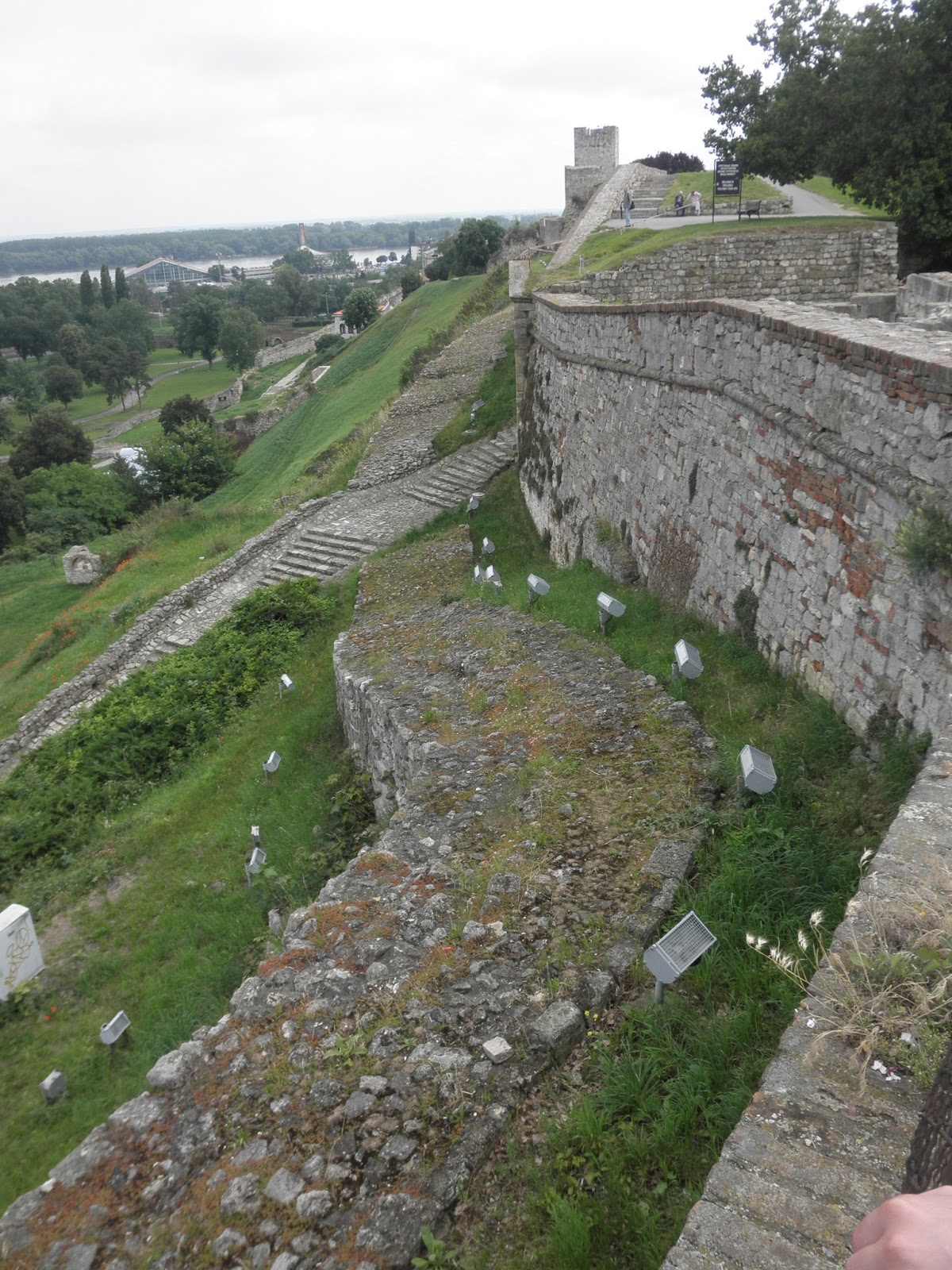
One of the first things we did in Belgrade was explore the giant Belgrade Fortress in Kalemegdan Park.  It is an impressive, hulking thing from which you can get pretty excellent views of the city, including the not one but two big rivers that meet here (the Sava and the Danube).  In the background of the following picture, you can see the two rivers that come to meet on the right side:


The fortress itself is a mess of older and newer passageways, parapets and reinforcements.  To give you an idea, here are a couple views of the fortress.


Also, apparently America is conducting a large PR campaign in the middle of the fortress.  Triangular structures showing flattering pictures of America as well as the location they were taken span probably a quarter mile of one of the paths in the fortress.  Here is the one we found taken in Chicago:


The campaign is called "AMERIKA IZ MOG UGLA," a name we found pretty amusing.  You should try saying it out loud, it's pretty good.  For better or worse, it has a much less amusing if perhaps more endearing translation, which is "America from my point of view."  You can also find more of the photography here, if you're interested.


I had said before that everything in Serbia reeks of cigarettes.  It's definitely true that smoking is much more popular here than in the USA, but still sometimes you see "No Smoking" signs, the classic cigarette in a circle with a line through it.  On the other hand, I think more often, you also see the following sign...


...which clearly says "Smoking Permitted Here" or something along those lines.  Now, I'm going to go ahead and take this as a positive sign.  I assume if places allowed smoking by default, they probably wouldn't have signs that explicitly say that you can smoke here.  I assume that was the case, probably not too long ago.  The proliferation of both this sign and its healthier, less-smelly sibling means that there are enough places where smoking is not allowed that it's worth it to clarify.  Still means that Serbia is generally pretty cigarette-ridden, but hopefully moving in the right direction.


Perhaps my most overarching observation thus far in Serbia is the shift we've seen from mostly Turkish/Ottoman architecture to more classical European elements, though there is definitely still a mixture.  Serbia was under the Ottoman Empire but less than Macedonia or Bulgaria, and it was under Austria at points, meaning that it had things that more resembled what we think of as European, like the following:


Contrast this with one of Belgrade's Serbian Orthodox churches, called Sveti Marko, which looks quite a bit more Ottoman, with the repeating domes as well as use of dark and light stones in stripes.


Overall, my opinion of Belgrade has definitely improved from my bleary-eyed first impression, perhaps aided most by Nikola Tesla.  Just saying, he was a pretty cool guy, and was apparently Serbian though he only spent one day in Belgrade.  Upon our visit to the Nikola Tesla museum, our guide informed us that "he was Orthodox Christian, so he was a Serb."  This says something pretty interesting that I'd like to touch on later about religion and nationality in the Balkans, but for now, I'll leave you with an image of one of Tesla's inventions:


By the way, let me know if you actually know any practical application for the Tesla coil, other than impressing your party guests.

Until later!  We hope you are all doing well!

Friday, June 7, 2013

Saw everything but the monastery...

Things don't always go as planned. Yesterday, we had the great idea to take the gondola up Mt. Vodno to take in the 66 m Millennium Cross, check out the views of Skopje, and then to hike the short distance down to St. Pantelejmon Monastery where we would be rewarded with 12th - century frescoes.  The ride up the mountain was great and we did in fact get great views:


The cross is indeed big:


The day was alternately sunny and cloudy which was great for hiking.  The weather on top of the mountain was noticeably cooler and we got nice views of the back face, including an adorable declaration of love in Cyrillic alphabet:


We saw so may beautiful wildflowers, some of which strange enough that we compared to a Dr. Seuss book, and others whose smells overwhelmed us.  One patch of white wildflowers near the end smelled so strongly of honey. At other times, the fields smelled of thyme and rosemary - I found one plant whose smell could pass as thyme but it was different than other thyme I've seen. I think there are a lot of different varieties though, so it may well be thyme after all.

Wildflowers:


After hiking mostly along the ridge line, we found this incredible disused military installation. You can see on the right side of the picture there's a watchtower with thin slats for viewing / firing. I assume that the bottom once held vehicles, but today only cows were there. We had heard their bells ringing eerily through the fields before we could find them!


These looked like parking spaces for vehicles as well. They were a few meters wide and went back perhaps 30 feet. The whole complex was a mix of these recessed walkways and elevated embankments, which I think were to limit sight lines to the outside, allowing people to move around without being spotted.


We saw several of these, which we assumed were for sleeping or storage. We didn't investigate!


Until this point we had been following what was clearly a road, but there was no clear road that led away from the military installation.  However, there was a trail, which we were relieved to see actually had trail markers, which was something we hadn't seen yet that day.  After continuing for awhile on the marked trail, though, we both agreed that it seemed we were walking too far along the ridgeline, away from the city.

We then took an unmarked but fairly clear path which earlier on had tire tracks in it. Later on, we lost the car tracks but the path was full of sheep or goat tracks and droppings, along with an occasional shoe print.

It was generally clear but not maintained at all, though it was a bit harrowing for 5-10 minutes when the path passed through some thick forest and became a muddy creek bed. We had to duck under brush and at some point came out into more open areas again (see note at meadows full of wildflowers!).

I don't remember where exactly we took this picture but it gives a sense of the descent and the mix of forests and meadows / pastures:


The first settlement we encountered - and man, were we relieved to be coming upon civilization again - was this picturesque Albanian village snuggled onto the side of Mt. Vodno:


We looked back on the mountain and thought of how far off course we were but how enjoyable the detour had been.


The village was very picturesque.


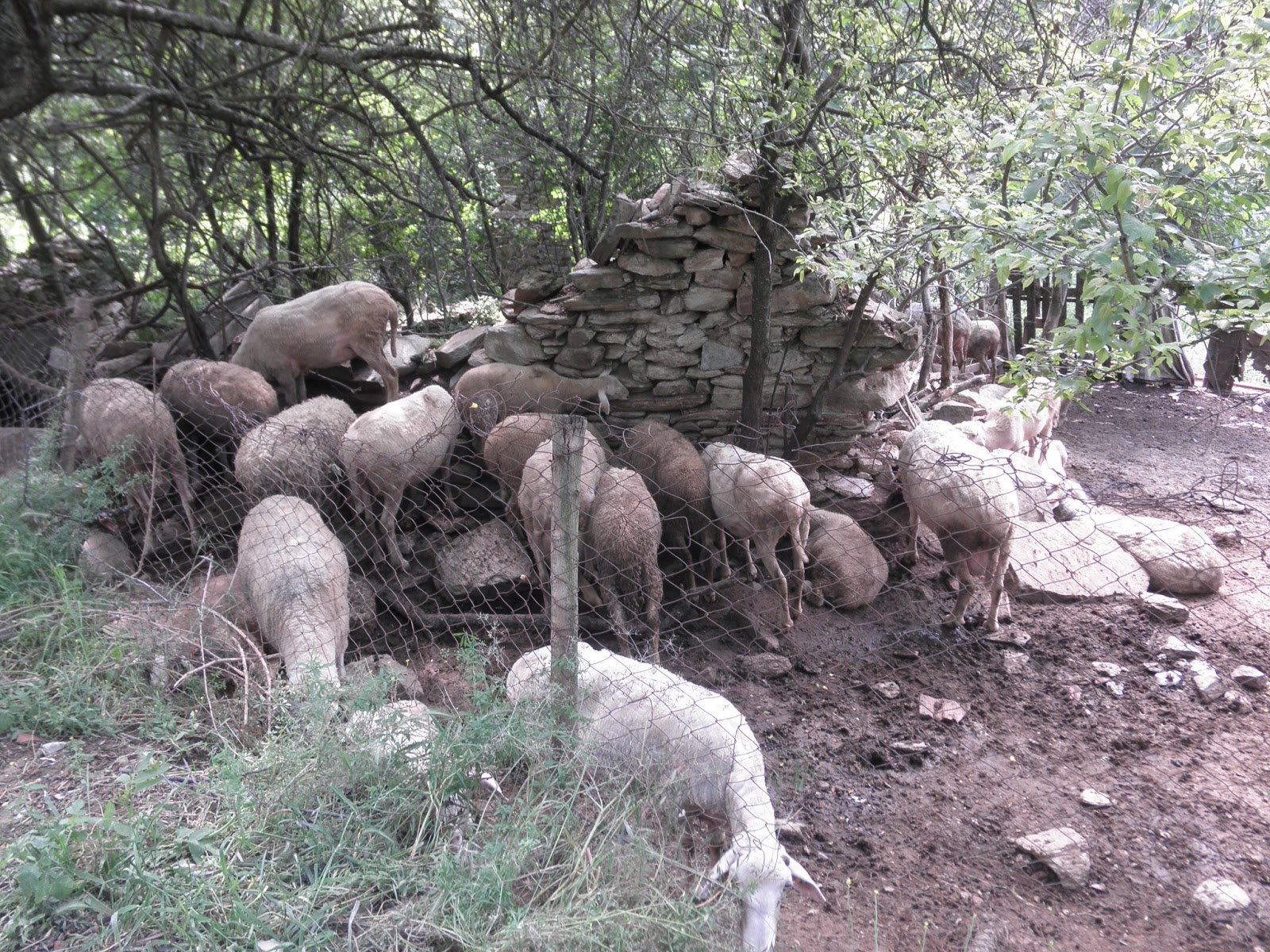
We found the sheep whose path we had probably been following - these also added to our repertoire of smells for the day, as you might imagine.


We never saw anyone in the first village (Gorni Krushopek according to Google Maps, as we found out later) and continued through fields, orchards, and the village cemetery, heading toward the city.


We thought we were done when we neared the bottom and looked back at the Millennium Cross, and the village of Gorno Nerezi, where the monastery is that we had meant to go to, in the middleground which we never made it to.  We could also tell we were pretty far afield from the city, as we were facing the side of the cross here, and the front of the cross faces the city.  As we began to head down, we started hearing increasingly loud, very Balkan folk music.


As we approached the sound of the music, we came to the second settlement of the afternoon, with a *paved road* and a house with a street number (a big victory after hours of hiking). Not sure of which way to head, we loitered a bit, and attracted the attention of a very kind old woman who was picking vegetables from her garden / farm for dinner, across the street from her house.

She quickly identified that we didn't speak Macedonian, and gestured for us to come sit on her porch, which we did. A few of her children and grandchildren watched, some with interest and others without, as she tried to figure out where the heck we were from and what we were doing. She brought us two glasses of orange juice each and talked for a bit, with us only understanding that she was bringing someone who spoke English.

That someone was her son who had just celebrated his wedding three days ago. She brought us each a slice of leftover wedding cake and we congratulated him and met his wife. It turns out he learned pretty good English working with a Turkish crew on a gas station project in this village on the outskirts of Skopje.  He told us that the Balkan folk music that had guided us here was from a middle school graduation occurring in town.  He also remarked that confused, lost-looking people turn up after failed attempts to see Sveti Pantelejmon monastery about once a week.  Whew.

After talking a bit more, the son tried to call a cab but the company said no cabs were available. In the end, he drove us a little bit into town to where we could easily catch a cab ourselves. 

Incredible people the world over! Reach out and help someone who looks lost in life.

And here's a rough google map of the route we took:


View Hiking down Mt. Vodno in a larger map

Thursday, June 6, 2013

Photo Gallery is here!

Hey all,
We had a ridiculous day filled with sights, sounds and maybe even more smells, but we're a little too tuckered out to write about it - we'll tell you all about it tomorrow.

In the meantime, I added a Photo Gallery!  There is a tab at the top of the page which will take you to it.  It will have pictures including ones that weren't on the blog, broken up into slideshows from each separate destination.  Enjoy :)

E&T

Wednesday, June 5, 2013

Macedonia: nationalism and lovely Skopje

Greetings from foggy Skopje! Guidebooks are not accurate about everything (ours, for example, promised a chairlift up the mountain in Sofia that was not in fact working), but they can be funny. Here's its take on Skopje:
"Skopje in winter is enveloped by an all-pervasive fog, symbolic of the conspiratorial overtones of a small Balkan city haunted by foreign diplomats and partisan intrigue."


LOL


We got here on a 6-hour bus from Skopje - 6 hours not because it's far as the crow flies but instead because the straight stretches of the two-lane road are short and are punctuated by steep ascents and descents on Balkan mountains. Slow semis creep up the mountains at perhaps 40 km/hour and we often waited behind them through blind turn after blind turn waiting for a chance to pass.

The Bulgarian and Macedonian countrysides seemed like a veritable temperate paradise - small village houses had gardens with hundreds of square feet of trellises with grapes which should be coming into season soon and, beyond them, fruit orchards and fields of tomatoes, peppers, eggplants, wheat, and corn.

Here in Skopje, we're staying with a friend of mine from college, Eric. He is a linguist who is doing his dissertation research right now on some shared features of Macedonian and Albanian (spoken by a large Albanian minority in Macedonia, including Skopje).

Skopje at 500,000 residents is much smaller than our previous stops, Istanbul (14 million) and Sofia (1.2 million). This has some pleasant side effects. The city is cheaper ($.60 for a cup of Turkish coffee vs. $2-3 in Istanbul; $.40 for 1.5 L of water vs. $1.5-3 in Istanbul) and much more walkable - from Eric's apartment in a nice residential part of town, it took us a full 15 leisurely minutes to walk downtown. What did we find?

Having been part of various other states (the Ottoman Empire until 1912, the Kingdom of Serbia which later became Yugoslavia), Macedonia only became an independent country in 1991 when it peacefully seceded from Yugoslavia.

You could easily imagine that a new young country might be interested in developing its own narrative of itself in all the usual areas - architecture, literature, music, art, etc, but that is not the whole story in Macedonia. In fact, Macedonia is locked in a bitter dispute with the Greeks over its very name.

Macedonia as a name for the region is very old, dating back at least to classical Greek times, and Alexander the Great was known to have been from these parts. The peoples of the region had different identities and spoke different languages back then, but the name has stuck, and is used both for a province of Greece and for the country. Greece is angry because they believe that the use of the name Macedonia contains an implicit claim over the Greek province, which Macedonia doesn't even make.

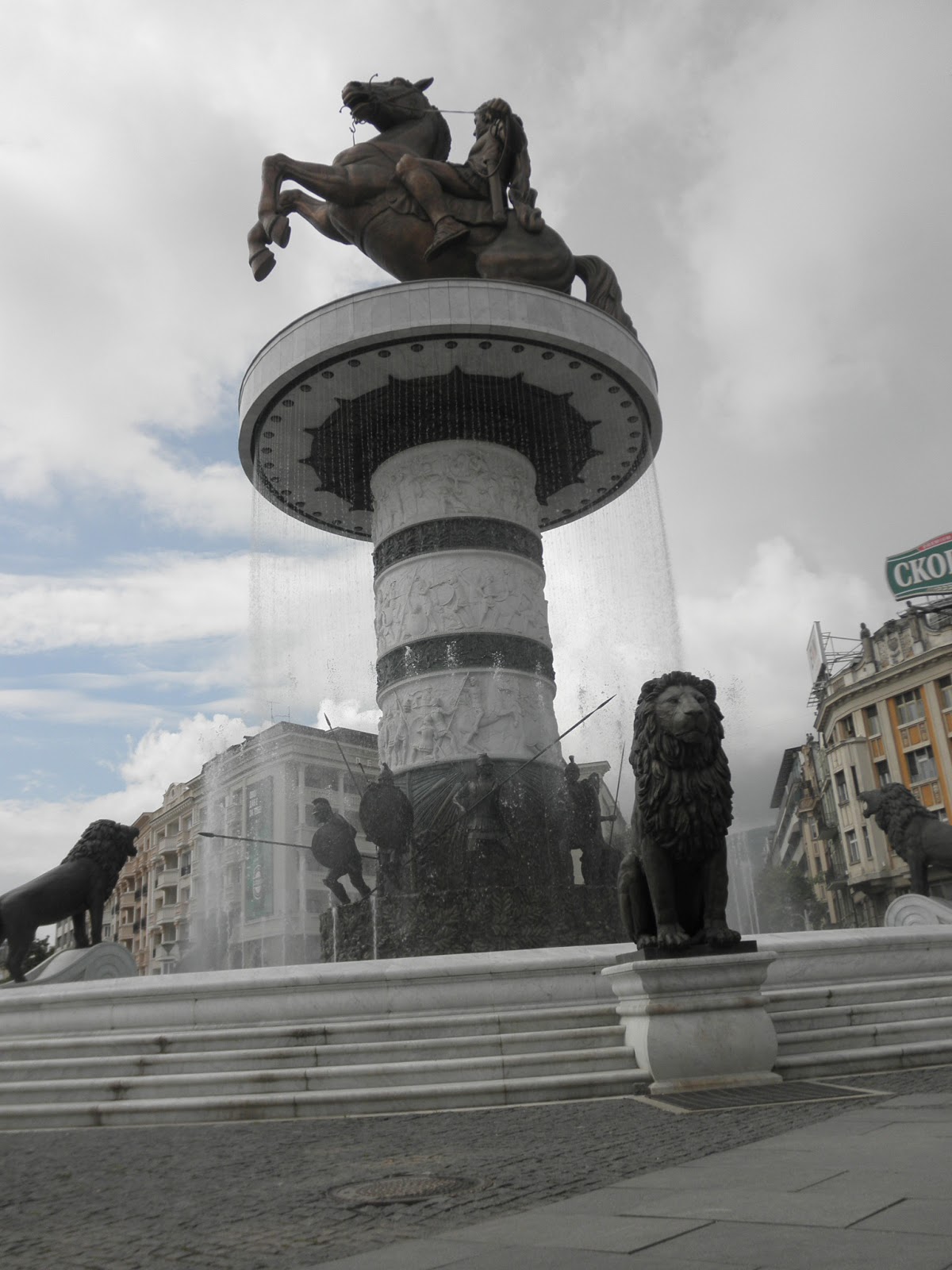
In what our host terms "a giant middle finger to Greece", Macedonia continues to fight the losing battle over using its name internationally and is in the process of stuffing Skopje's downtown with pretty ostentatious statuary. This one is officially called Warrior on a Horse ...


... but everyone knows it's supposed to be Alexander the Great. The scale might be hard to see here but the statue is 22m tall - 10x life-size! It also plays classical music in the afternoon and evenings, coordinated with changes in the fountain. It looks even more classical when you check out the spearmen at the base:


The small territory of Macedonia has had another famous son, Justinian I (who built the Hagia Sophia / Aya Sofya from Istanbul):


 To reach the old city across the river, we crossed the incredible Kamen Most, built in the 15th century by the Ottomans on Roman foundations, touched up a few times over the years.


We toured pretty much all of the old city, including the Ottoman Fortress, the serene and understated Mustafa Pasha Mosque, the fruit and vegetable bazaar, and a lovely antique shop.

The highlight was the 17th c. Sveti Spas Church. The signs were eager to point out that as a legacy of Ottoman strictures, Christians had to keep their architecture restrained, and the building is in fact sunk 2 m into the ground. We expected something much grander and walked around three sides of it before realizing it was the church we were looking for.


The church has a 19th c carved wood iconostasis which was just incredible.


A detail of the intricate carving that it had on every part:


Lastly a shoutout to everybody back in the US and especially Michael: miss you guys and hope you're having a great summer!


Tuesday, June 4, 2013

Македонија, anyone?

Yesterday was our second and unfortunately last day in Sofia/Софиа, Bulgaria.  We certainly had a slow start to the day after missing the bus to the Rila Monastery, but we ended up hiking up the Goli Vrah mountain just south of Sofia to Dragalevtsi Monastery (Драгалевци Манастир).  It was beautiful, though apparently much smaller than Rila Monastery.  Photos hopefully coming soon (we left our camera in Bulgaria... we're working on fixing that problem...).

Anyway, we had cooked Indian food for our hosts two nights ago and had leftovers with them last night, which was really nice.  Both nights, Victor gave us home-made wine from a friend of his.  When we gave them a gift of some maple syrup and some Turkish Delight, they made tea and shared them with us (we didn't take too much).  We woke up this morning to eat banitsa - баница (a traditional Bulgarian pastry with basically feta inside it) - made by Victor's mother, a certified Bulgarian grandma.  It was awesome.

You might notice that Macedonia - Македонја - was not on our original map.  We've been in a bit of limbo with our schedule, but it seems like the plan will be to go from here to Belgrade in Serbia instead of Sarajevo in Bosnia, basically just because of the difficulty of getting to Sarajevo from Macedonia.  From Belgrade, we'll just continue on to Ljubljana.  Once we get to Vienna, we have all our train tickets bought, so no more changes past then.

Ok, I have a few things to figure out, re: camera, couchsurfing for future destinations, etc.  Eek.

Sunday, June 2, 2013

In Bulgaria.

Hey all,
Just wanted to let you know that we're safe in Sofia, Bulgaria.  Thank you so much for your emails & expressions of care.

Before I move on to our time in Bulgaria so far, I want to touch on the Istanbul riots a bit more.  Before we came back over to the European side for the last time, we saw tons of people holding and selling Turkish flags, a ferry ship full of people waving flags, yelling and wearing masks, and groups of police walking around carrying batons.  The energy was palpable and much more than we had seen on the Anatolian side of Istanbul just the day before.  Plus, we've heard that riots have spread to other cities in Turkey.  On our ferry ride across the Bosphorus, everyone on the boat was buzzing with talk about the protests.

Of course, we did our best to avoid Taksim square and Besiktas once we were over on the European side (we were lucky the ferry was running, by the way).  And actually, it was totally calm.  We hardly saw any protesters.  When we were waiting for the bus that formed the first part of the trip to Bulgaria, we wondered if some of the other tourists maybe didn't even knew about what was going on.

I also wanted to talk about the New York Times article written about the protests - click here for the article.  One thing I noticed was that they compared Taksim Square in Istanbul to Tahrir Square in Cairo - an interesting comparison, but Tim and I agreed that this seemed like quite the editorial remark.  It's just a central square in a city - you could say it's the 'equivalent' of any other similar square.  I compared it to Las Ramblas & Placa Catalunya in Barcelona.  It still remains to be seen, of course, whether or not these protests turn into something like what happened in Egypt.

On the other hand, I found certain aspects of the NYTimes article to be really quite accurate.  In my last post I described how we had spent an evening just sitting and chatting in the park next to Taksim Square the night before things really got going.  The NYTimes describes it as having a "festival-like atmosphere," and I was actually surprised how well that describes it.

I feel so lucky to be safe, and actually, I also feel fortunate to have seen what was going on there with my own eyes.  It was unlike anything I've ever seen before, and really opened my perspective.

Also, we just saw on CNN (which our Bulgarian hosts have on partially for us) and it says that Syria is officially warning its citizens not to go to Turkey because of the danger that the protests present.  Lol.

We did have some concerns about the transportation to Bulgaria possibly being cut off, and all in all we were lucky.  The trip, scheduled to take a mere 12 hours to reach Sofia, ended up taking 16, and we ended up getting mildly scammed.  On the other hand, we actually were able to get basically a full night's sleep on the train - we had a compartment to ourselves - and we found our new Couchsurfing hosts relatively easily.  Plus, there were some pretty nice views in those extra hours of being on the train:


Our new hosts are a couple with a 4-year old son, and they are great.  She is a computer programmer, he is a chemist, and their son is cute and very energetic.  Both of the adults speak good English, actually better than our last host.  After arriving at almost 4pm (we were supposed to arrive around 11am) we were able to walk around Sofia with the woman, whose name is Polina.

Sofia is a small city, and actually Polina and her husband Victor have both gently mocked us for choosing to come here.  True, a lot of the architecture is based on the concrete block hearkening back to the Communist days, but actually Sofia has some pretty cool stuff to see.  There are lots of old churches and buildings, but what I think Tim and I both thought was the coolest was the ancient stuff.  We basically stumbled over tons of little pieces of the ancient Roman city, which Polina told us were just found in the process of trying to build things like new metro lines.  She said it's actually kind of a pain, because then they feel like they have to stop building or build around the ancient city.  Unfortunately, I forgot to bring the camera along for our walk, but it was quite picturesque at parts.

Tomorrow we're considering renting a car to get to Rila Monastery, which is supposed to be pretty amazing and have wonderful hikes.  Maybe we can bring a picnic :).  Anyway, going to go to bed - goodnight all!